Wondering whether your next Columbus home can actually support the way you work now? If you work from home full time or split your week between home and the office, the right space is about more than square footage. You need a home that fits your routine, supports focus, and still makes everyday life feel manageable. Let’s dive in.
Why work-from-home needs are different
Working from home changes what “functional” means in a home search. A guest room that looks fine on a listing sheet may not work if you need video-call privacy, strong internet, and space to separate work from daily life.
In Columbus, that question matters for a lot of households. The city already has a strong broadband baseline, with 93.6% of households reporting a broadband subscription, and Franklin County comes in at 94.1%. Nationally, 13.3% of people worked from home in 2024, and regional planning in Central Ohio still treats telecommuting as part of the commute mix.
That means your search should focus on how you work, not just where you want to live. A downtown condo, a townhome, or a detached home can all work well, but each supports a different kind of routine.
Start with your real work pattern
Before you compare listings, take a step back and think about your weekly schedule. The best home for a fully remote worker may not be the best fit for someone who still heads into the office two or three days a week.
Ask yourself a few simple questions:
- Do you work from home every day or only part of the week?
- Do you need a separate room with a door?
- How often are you on video calls?
- Do you need quiet during the day?
- Will more than one person work from home at the same time?
- How often do you still drive to an office, meetings, or the airport?
Your answers help narrow the kind of space that makes sense. In Columbus, the right fit often comes down to convenience versus separation, and shared amenities versus private square footage.
Downtown Columbus can work well
If you want convenience and a lower-maintenance lifestyle, downtown Columbus may be a strong option. Columbus zoning supports a mixed-use downtown core, with residential, retail, office, parking, institutional, and other uses allowed in the Downtown District.
That mix makes downtown condos and apartments a natural fit for buyers who want a smaller footprint and building amenities instead of a large private lot. For some remote workers, that trade-off makes daily life easier.
What downtown living offers
Some downtown residential buildings highlight why this setup appeals to work-from-home buyers. Examples in the market include features like fitness centers, concierge services, valet parking, business centers, clubhouses, controlled access, covered parking, on-site management, and maintenance-focused ownership.
If you do not need a large home office, those shared features can offset a smaller private space. You may be able to work from your unit most of the day, then use building amenities and nearby services to keep your routine simple.
When a condo makes sense
A downtown condo or apartment may be a good fit if you:
- Work mostly on a laptop
- Do not need a large dedicated office
- Want less exterior maintenance
- Value shared amenities
- Make occasional office trips and want central access
- Prefer a smaller home base with city convenience
That said, smaller spaces can require more planning. If your workday includes frequent calls, specialized equipment, or two people working side by side, you may outgrow that layout quickly.
Detached homes offer more separation
If you need privacy, flexibility, or room to grow, a single-family home may be the better match. Columbus zoning includes multiple single-family districts along with suburban residential, rural residential, and planned development categories that support detached-house living.
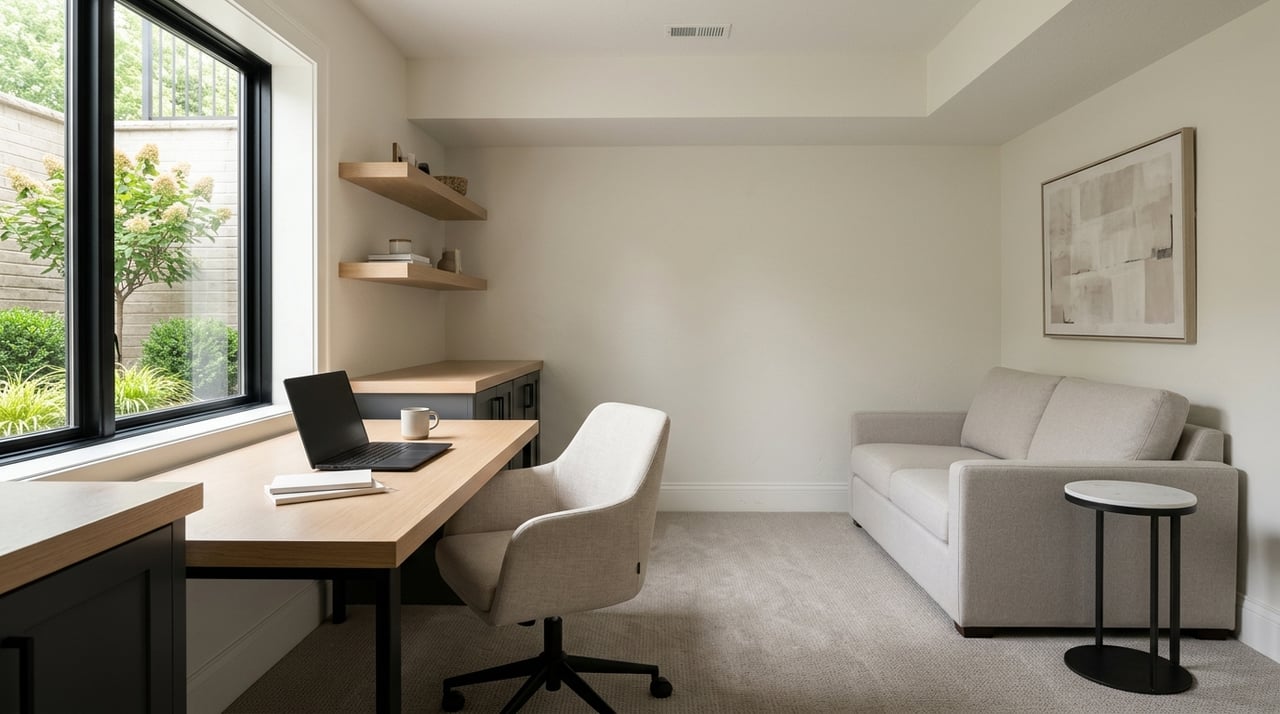
For many buyers, that matters because a detached home often gives you more options for setting up a true office. A bonus room, loft, finished basement, or spare bedroom can create the separation that makes remote work easier and more sustainable.
Why extra rooms matter
Working from the kitchen table may be fine for a short stretch, but it is harder over time. If your household is busy during the day, a room with a door can make a big difference for focus, calls, and work-life balance.
This is especially important for hybrid buyers. Even if you only work from home part of the week, a dedicated workspace can help you stay organized and make office days feel less disruptive.
What to look for in a suburban home
As you tour homes in Columbus and Franklin County, pay attention to layout as much as size. The most useful work-from-home spaces are not always the biggest ones.
Look for features like:
- A bedroom or flex room away from the main living area
- A loft that can hold a desk setup
- A finished basement with usable light and outlets
- Built-in storage for files and equipment
- A floor plan that separates work zones from family zones
- Space for two desks if needed
In many cases, the goal is not just more square footage. It is better-functioning square footage.
Compare city and county trade-offs
As you weigh options, it helps to understand how the city and county differ. Columbus has an owner-occupied housing rate of 44.1%, while Franklin County overall is at 52.8%. The median owner-occupied home value is $252,900 in the city and $288,400 in Franklin County. Median gross rent is similar in both, at around $1,300.
Those numbers suggest the decision is not only about price. It is often about the kind of space, privacy, and maintenance level you want.
Here is a simple way to think about it:
| Option | Best For | Main Trade-Off |
|---|---|---|
| Downtown condo or apartment | Convenience, shared amenities, lower-maintenance living | Smaller private workspace |
| Detached home in city or suburbs | Dedicated office, more separation, flexible layout | More home to manage |
| In-between options | Hybrid routines, balanced location needs | May require compromise on space or commute |
Commute still matters in Columbus
Even if you work from home most days, commute and mobility should still be part of your search. In both Columbus and Franklin County, the mean one-way commute is 21.5 minutes, which is shorter than the 2024 national figure of 27.2 minutes.
Regional data also shows that Columbus remains heavily car-oriented. MORPC reports that 77.5% of commuters drive alone, while 3.4% use transit, biking, or walking, and 19.1% report other modes, including telecommute, as their primary mode.
That means many buyers still need a home that supports occasional office trips, errands, appointments, and airport runs. A home that feels perfect on a Tuesday may feel less convenient if your Thursday starts with a drive across town.
Think beyond the office
Your weekly routine is bigger than work. You may still need to factor in child care drop-offs, groceries, appointments, and social plans.
The City of Columbus offers multiple ways to get around, including COTA local lines, Park & Ride locations, shared mobility options like Spin and Veo, a growing bike network, and more than 200 miles of Central Ohio Greenways paths. Some buyers will want to mix driving with transit or biking, while others will stay mostly car-dependent.
Downtown access and parking count too
If you are considering downtown, be realistic about access and traffic patterns. The I-70/I-71 corridor through downtown carries about 150,000 vehicles and 17,000 trucks per day.
Even if you only commute once or twice a week, parking, highway access, and congestion can still shape your routine. For some buyers, that reinforces the appeal of central living. For others, it supports moving farther out for more space.
Check internet by exact address
In Columbus, broadband access is generally strong, but you should still verify service at the exact property you want to buy or rent. Neighborhood-level assumptions are not enough.
The most practical screening tool is the FCC National Broadband Map. You can search by address and review which providers report service there, what technology they use, and the maximum advertised speeds.
That tool is useful, but it has limits. It shows reported availability, not actual day-to-day performance, affordability, or adoption. Use it as a first step, then ask follow-up questions before you move forward.
Your broadband checklist
Before making an offer or signing a lease, check:
- The exact street address on the FCC map
- Which providers serve the property
- What internet technology is listed
- The maximum advertised speeds shown
- Whether the listing details match what is reported
This small step can save you from a big surprise after move-in.
How to choose the right space
The best Columbus home for remote work is the one that matches your real routine. If convenience and shared amenities matter most, a downtown condo may be the right call. If you need a quiet office, room to spread out, and clear separation between work and home life, a detached home may serve you better.
For many hybrid buyers, the answer lands in the middle. You may want enough room for a dedicated workspace, while still keeping occasional office trips and everyday mobility manageable.
When you shop with a clear plan, it is easier to spot the homes that truly support your life. That is where local guidance makes a difference, especially in a market as varied as Columbus and greater Franklin County.
If you are weighing downtown convenience against suburban space, The Agency Real Estate Group can help you narrow the options and find a home that fits the way you actually live and work.
FAQs
How do I choose a Columbus home for working from home?
- Start with your actual work routine, including how often you work at home, whether you need a separate office, and how often you still commute or run errands.
Is a downtown Columbus condo enough space for remote work?
- It can be, especially if you want a smaller footprint and shared building amenities, but it may be less ideal if you need a large private office or space for multiple people to work at home.
Should a Columbus hybrid worker still care about commute time?
- Yes. Columbus remains a car-oriented region, and even hybrid workers often need to factor in office trips, errands, airport runs, and parking.
How can I check internet service at a Columbus property?
- Use the FCC National Broadband Map to search the exact address and review reported providers, technology type, and maximum advertised speeds.
What home features help most with working from home in Franklin County?
- A separate room with a door, flexible bonus space, storage, and a layout that creates distance between work areas and main living areas are often the most useful features.